Thursday, May 13, 2010
Britt, How did you get involved in conservation work?
I grew up on the southern coast of Maine and started my work in South Africa in 2000 for a small, family owned and operated safari company. As my passion grew, my path in Africa took me from the tourism industry; wildlife capture, relocation, and monitoring assignments; nationally qualifying and registering as a certified Field Guide; working with communities on small business development projects in rural areas; and eventually to working as an international conservation and sustainability consultant for various non-profit foundations and corporations.
But more simply put, my love of wilderness set me on a path of experiences. I've also been so blessed to have wonderful mentors in the conservation field, from my family, Dr. Ian Player, Vance Martin, and others.
Tell us about the Friedkin Conservation fund and the goals.
The Friedkin Conservation Fund (FCF) is a registered (US and Tanzanian) non-profit, non-governmental organization incorporated in 1994 (Certificate of Registration SO.NO.9807). Their role is to assist the Tanzanian Government with the conservation and preservation of more than nine million acres of Tanzania's protected areas. They achieve this through our internationally recognized anti-poaching initiative, their innovative community development program and their field research projects. Based out of Arusha, northern Tanzania, they operate in five Game Reserves, two Open Areas, three Forest Reserves and one Game Controlled Area.
Our mission is to:
Provide proactive assistance to the Government and the people of Tanzania with their efforts to conserve and preserve their Protected Area network
Engage rural communities in the conservation of their natural heritage and empower them to alleviate some of the conditions in their lives that contribute to poverty
Monitor, research and facilitate developments in sustainable utilization of natural resources.
What are the successes of the organization?
Focusing on the anti-poaching arm of FCF...
During 2005 and 2006 our teams were responsible for the arrests of some 3,884 poachers. Their seizures included 209 illegal firearms, 15 elephant tusks and nearly 16,000 planks of illegally logged hardwood. 2007 ended on a very high note. The anti-poaching teams finished the year with a total of 2,131 arrests and 91 confiscated firearms.
FCF was recognized as the APHA's ‘Ox of the Okavango' for 2007 - an award presented to the conservation organization of the year as decided upon by the members and board of the APHA.
FCF's training and work in the field has been filmed and broadcast by ESPN and the Animal Planet Channel.
How many poachers were arrested before FCF came about?
Zero
What is the current poaching situation in Tanzania?
Poaching levels in Tanzania are significant. Bushmeat, hard wood timber and ivory poaching are very predominate. Organized and subsistence poaching affect all nine million acres of FCF concession areas. CITES decision to not downgrade the elephant's status in Tanzania is a key indicator of the level of severity of poaching levels in Tanzania and how seriously everyone needs to continue the anti-poaching initiatives! In the areas which FCF is responsible for, in excess of 2,000 arrests are made per year. How much more can be done with additional resources?
Every year FCF needs to replace tents, sleeping bags, and other supplies used by our staff in the field. Vehicle expenses are always high, considering the rough country FCF patrols and works in on a daily basis. Microlights operational costs take up a large portion of our budget. Thankfully, FCF has just received a major commitment from Safari Club International to help purchase a new mircolight and aid in the maintenance cost for five years! FCF is committed to providing higher salaries to their rangers and continuous additional training that encourages field personnel to perform to a higher standard.
I also want to note, something very rare in the non-profit world, that 100% of donations goes to the projects on the ground. All overhead and salaries are covered separately from a private donor.
Here is an example of the costs associated with one team (15-20 people) of FCF's private rangers for one year.
Expense One Year, One Team
Salaries $7,500.00
Rations $5,925.00
Uniforms $700.00
Game Scouts $2,030.00
Advancement Training $1,500.00
Performance Bonus $1,540.00
Contingency $2,000.00
Vehicle Fuel & Maintenance $22,000.00
TOTAL $43,195.00
I understand that FCF is more then just an Anti-Poaching Crusade, Tell us a little bit about the community development work that is also going on in Tanzania?
For FCF, it is not enough to conserve only wildlife. Conservation must include entire ecosystems and the human communities that live in and around these ecosystems. The Community Development Sector has been established to meet FCF's mission to practice inclusive, people-oriented conservation.
Vision:
For communities in and around our concessions to attain and appreciate benefits through sustainable use of their natural resources.
FCF projects, designed in close collaboration with villages, district officials and the Wildlife Division emphasize the importance of conservation achieved simultaneously with sustainable development. Two field officers, together with anti-poaching team commanders and concession managers, work on the ground with representatives of eleven districts and over one hundred villages. This daily, personal interaction provides groundwork for solidly designed community-owned projects that improve the quality of living around Tanzania's protected areas and highlight the benefits of conservation. I understand FCF has had various equipment sponsors and funding from private sources as well as SCI, Can you tell us a little bit about these sponsors?
Equipment Sponsorship- FCF has been fortunate to receive donations from organizations such as SureFire, ColdSteel, Leopold optics, etc. High quality equipment is very difficult to obtain in Tanzania and these generous donations go a long way in increasing FCF's effectiveness on the ground. It is a good two-way relationship as these companies get to have their products thoroughly tested in the extreme field conditions that anti-poaching operations provide and FCF gets the top quality equipment for their rangers.
Financial Sponsorship- this continues to be an important component for FCF allowing them to go that extra mile on the ground. Most of these sponsorships are targeted at the community development and include student school sponsorships tree nursery initiatives, renewable energy services in clinics, water well construction, etc. These donations come from private individuals as well as from generous organizations such as the Mzuri Wildlife Foundation, Safari Club International and Dallas Safari Club.
FCF is so grateful for the continued assistance from these various sources - it all makes a huge difference! Asante sana - thank you very much! FCF is also eager to collaborate with other organizations on conservation-related issues. Please contact us if you feel our organizations can benefit from each other on such matters!
U.S. Contact Information
Britt Hosmer - FCF US Representative
britt@rockenvironmental.com
POSTED BY KEVIN C PAULSON
Visit the Hunting Life Blog - http://www.huntinglife.com/blog/detail/interview-with-britt-hosmer-friedkin-conservation-fund-us-representative
Showing posts with label Friedkin Conservation Fund. Show all posts
Showing posts with label Friedkin Conservation Fund. Show all posts
Thursday, May 13, 2010

Monday, April 5, 2010
Over 50,000 trees!
Friedkin Conservation Fund: Tanzania -- www.friedkinfund.org
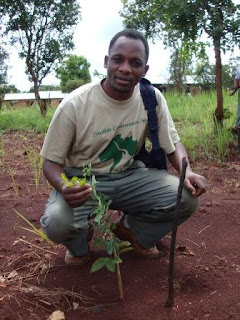
It was encouraging to see the efforts of the student environmental groups in establishing tree nurseries and planting trees. Overall, the project is proving to be successful in getting students involved in environmental activities and in planting trees on their campuses and at home.

The project has had varying levels of success in different schools depending on the level of student motivation and the responsiveness of the teachers to get involved and help oversee ad guide the student initiative.

Over 50,000 trees have been transplanted in the first phase of planting over 30 schools since the project started in November 2010. We are continuing to follow-up with the school groups and will continue to offer support to strengthen the initiative and maintain the momentum.

It was encouraging to see the efforts of the student environmental groups in establishing tree nurseries and planting trees. Overall, the project is proving to be successful in getting students involved in environmental activities and in planting trees on their campuses and at home.

The project has had varying levels of success in different schools depending on the level of student motivation and the responsiveness of the teachers to get involved and help oversee ad guide the student initiative.

Over 50,000 trees have been transplanted in the first phase of planting over 30 schools since the project started in November 2010. We are continuing to follow-up with the school groups and will continue to offer support to strengthen the initiative and maintain the momentum.
Wednesday, January 27, 2010
Friedkin Conservation Fund - Anti-poaching - Tanzania
The Friedkin Conservation Fund (FCF) proactively assists the Tanzanian Wildlife Division by providing highly motivated, well trained anti-poaching teams to help combat activities such as commercial ivory and bush meat poaching, illegal logging and charcoal burning.

Training and Personnel
We have trained, equipped and deployed 85 full-time field rangers who work under the guidance of 5 concession managers and 2 mobile anti-poaching coordinators in the field who report back to our office in Arusha. These field staff and managers are configured into 12 Rapid Action Teams, 1 Village Game Scout Team and 2 Specialist Mobile Anti-Poaching Units.
Equipment
Each of our anti-poaching teams uses a fully-equipped Land Cruiser, and operates with camping gear, all-weather uniforms, GPS and radio support.

FCF has been fortunate with equipment sponsorship and funding from generous parties, and continues to appreciate assistance to maintain this costly operation. For areas where poaching on water is prevalent we use canoes and motorized boats. Our microlight program was launched in 2006, and has been incredibly productive in identifying high-impact areas that are then patrolled by the teams on the ground. Also at our disposal is the Maule, our small yellow airplane that is used primarily for reconnaissance work.
Results and Recognition
During 2005 and 2006 our teams were responsible for the arrests of some 3,884 poachers. Their seizures included 209 illegal firearms, 15 elephant tusks and nearly 16,000 planks of illegally logged hardwood. 2007 ended on a very high note. The anti-poaching teams finished the year with a total of 2,131 arrests and 91 confiscated firearms.
FCF was recognized as the APHA’s ‘Ox of the Okavango’ for 2007 – an award presented to the conservation organization of the year as decided upon by the members and board of the APHA.
Our training and our work in the field has been filmed and broadcast by ESPN and the Animal Planet Channel.

Thursday, January 14, 2010
From Planyoursafari.com
Hi Britt,
Nice that the Friendkin fund comes up as I worked between ‘94 and ‘96 for the Friedkins with Ker & Downey in Tanzania. I remember that the emphasis was on the villages surrounding Tarangire National Park. We built an airstrip on communual land and money from planes landing and taking off was put back into the community. We also bought our vegetables from the villagers and the company put in a school and a well-point.
Hello Johan,
The Friedkin Conservation Fund (FCF) is a registered (US and Tanzanian) non-profit, non-governmental organization incorporated in 1994 (Certificate of Registration SO.NO.9807). Our role is to assist the Tanzanian Government with the conservation and preservation of more than 9 million acres of Tanzania’s protected areas. We achieve this through our internationally recognized anti-poaching initiative, our innovative community development program and our field research projects. Based out of Arusha, northern Tanzania, we operate in five Game Reserves, two Open Areas, three Forest Reserves and one Game Controlled Area.
Yes, they are – and have been – doing good things. As you know, FCF was started by the Friedkin’s to improve local community relations and privately combat anti-poaching on their 9 million plus acres worth of concessions in northern Tanzania. It’s amazing to see how these humble beginnings, from a humble family, have truly grown to become an impressive NGO.
We’ve developed some more interesting community and conservation projects:
Organic/Fair Trade Bee Keeping – honey and wax production
Village Community Bank (VICOBA) – microfinance and savings
Reforestation – over 30,000 trees replanted last year
Environmental Education – mobil film screening
Anti-poaching – over 2,000 arrested last year alone
Scholarships – primary, secondary, and advanced degree grants
Scientific Research and GIS mapping
Lion Aging and Population Research
Building Teachers Houses and Schools
Building of Medical Clinics – with UV water filtration, mircoscopes, and solar panels
Borehole DrillingI feel very proud to be a part of it!
Cheers, Britt Hosmer


Subscribe to:
Posts (Atom)
There are some folks doing amazing things in conservation. The Friedkin Conservation Fund, a 501(c)3 registered in Houston, TX and in Arusha, Tanzania – truly does give 100% of donated gifts to the field. All operating costs, salaries, and overhead is privately funded. For a small NGO they are doing some big things for community development, wildlife, clean water, anti-poaching, education, and scientific research. For more information go to http://www.friedkinfund.org or contact the US Rep atBritt@rockenvironmental.com.